
In this article I will cover a few additional growing containers that can be used in recirculating water methods to grow food. I will provide a few visuals of vertical containers, raised wicking beds and roof gutters that enable use of soil. Honestly, there are so many “containers” and methods that can be used in recirculating water method of growing food – you just need to look around you and utilize what is readily available: hollow Bamboo for NFT’s, 1 gallon milk jugs or other such “food safe”.
Vertical Containers – some examples

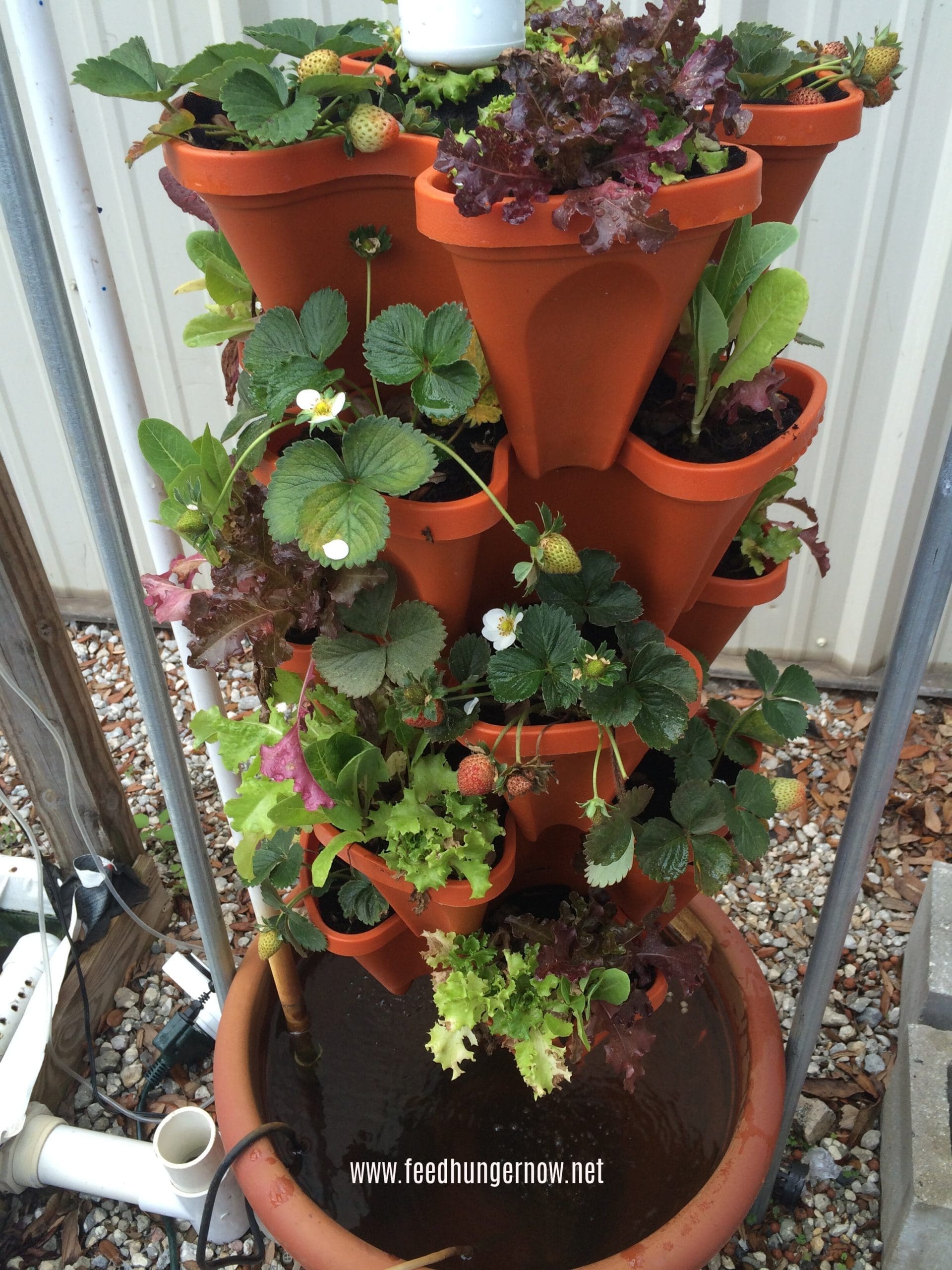
Vertical Tower – Self Contained
This small vertical tower provides 20 growing pots to grow a variety of plants. It only requires 4 SF of space. The grow pots are 6 inches wide. There are other such towers which offer much large and deeper growing pots to increase the range of plants that can be grown.
There are a lot of options for setting up vertical towers. Nutrient rich water is usually fed from the top and soaks down to recirculate or drain to the bottom base container. This can result in overwatering the top containers while the bottom containers remain dry, thus the watering system needs to be designed to address this shortcoming. Choice of media is also a factor when considering what is being grown and the frequency of providing nutrient solutions. The vertical towers may need to be rotated on occasions so as to ensure sufficient light for all plants. The main advantage of vertical towers, especially for the home gardner, is the ability to dramatically increase the overall growing space. Being compact, they provide excellent food growing options for the apartment dweller who may only have a very small patio or for indoor growing – see some examples below.
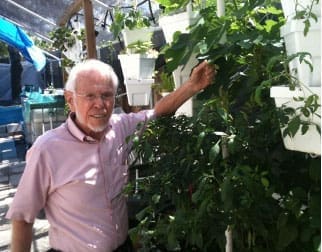
Bert Roper inspecting vertical towers
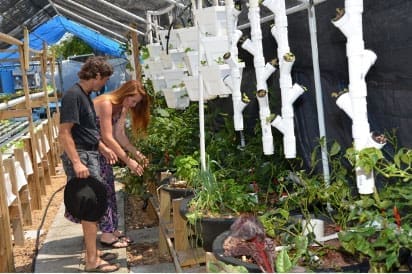
Susanne Friend & Tim Mann (Friendly Aquaponics) looking at hybrid growing methods

Vertical Towers utilizing Vertigro pots

Multi Vertical Towers (large pots) in a small space
Raised wicking beds: Raised beds are common feature in home gardens. Utilizing recirculating water food growing methods, the raised beds, being 12 inches deep, are modified to allow for the excess water to drain back to the sump. Nutrient rich water is fed to a pipe that runs at the bottom of the bed that is filled with soil. The water “wicks” up via capillary action thus enabling the roots to be feed – see the picture below

Raised Wicking Beds
The nutrient rich water can be fed continuously or be on a timer (the system can also be modified to be fed only as needed by adding a float valve). The excess water is drained out via the overflow valve and returned to the sump for recirculation.
Roof and other drainage Gutters: The roof and other drainage gutters allow nutrient rich water to be collected in a narrow container so that it is available for the container plants via wicking – capillary action. A system designed by Larry Hall in 2011 (Larry Hall Rain Gutter Grow System), has become very popular with home gardeners. Around the similar time, I started using roof gutter pans. I placed poly bags filed with my own soil mix to circulate the effluent rich fish water from my Aquaponics systems. I find this significantly increased my growing range and options. The picture below shows the level of water they hold:

Roof Gutter Pans
The roof gutter pans hold just over an inch of water. The drainage overflow can be adjusted to either decrease or increase that level. Containers are placed inside them and water is wicked up to the roots. This system also allows for “top dressing” of nutrients as needed for individual plants. The “Dutch Bucket” growing system can also be incorporated in these pans.
Options: Vertical systems are increasingly in popularity in commercial food growing operations. They offer significant increase in growing capacity in controlled temperature agriculture environments. Roofs have also become a viable option in many cases. If weight considerations are met, SWC growing methods offer many food growing opportunities utilizing recirculating g=food growing methods, see below
Each of these growing containers provide you options to grow a variety of food. You can utilize just one type or all of them.

SWC mounted vertically
The SWC raft system growing leafy greens weighs approximately 40 lbs SF. These systems could be used on roofs which usually have a significantly higher weight load capacity
This concludes the articles on the design and components of the Zero Lot aka Kitchen Garden. Future blog articles will cover food growing topics and individual project that Feed Hunger Now is undertaking as a result of your generous donations.
Feed Hunger Now looking for a solution to end hunger
Feed Hunger Now is a 501(c)3 nonprofit organization, is stepping up to the challenge. Our vision is “A world without hunger”, and our Mission is to “Inspire the building of sustainable local food gardens”.
Feed Hunger Now will work with individuals, community and nonprofit organizations, schools and government agencies to inspire, engage, educate, and empower individuals to grow food sustainably by incorporating recirculating farming methods including Aquaponics and Hydroponics to substantially increase locally grown food that is free of harmful chemical fertilizers or pesticides while using the lowest carbon footprint thereby help increase food security, reduce hunger and provide better access to nutritious, affordable, fresh, locally grown healthy food and domestic green job opportunities.
Will you join us in this journey?
Please consider making a donation.
Your donations will make a positive impact by enabling us to fund a portion of the costs of the monthly farm tours, host training workshops and provide associated manuals, cover staff costs and assist the building and installation of sustainable food gardens using recirculating farming methods including Aquaponics and Hydroponics. This will empower individuals and communities by providing solutions to end hunger rather than continued continued reliance on food aid.
Feed Hunger Now is a 501(c)3 non profit organization. Donations are tax deductible. Florida State Charity Registration Number CH 41373.
Prefer to donate by check or cash? Please complete our information form and send to:
Feed Hunger Now, P.O.Box 105, Goldenrod, FL 32733 USA


