A model to follow to grow healthy food by building sustainable local food gardens using recirculating water methods including Aquaponics and Hydroponics.

I held the inaugural Aquaponics training workshop on December 10th, 2011 in Winter Park, FL where I had set up a boutique research food garden incorporating recirculating water methods largely based on Aquaponics. One of my challenges for this hands-on Aquaponics training workshop was how to incorporate the numerous food growing methods into a simple to understand the system. I also wanted to design a system that could be used by all regardless of the ability to work the ground soil and one that could be changed according to what was to be grown or the particular site needs.
I named the Aquaponics hybrid food growing system “Sahib’s Zero Lot” and built the initial setup during our two day hands on training workshop involving the participants. I initially introduced two growing methods, one based upon the raft system and the other using media beds explaining that different growing mediums that could be used, how to mix the media for optimum ease in planting of seedlings and subsequent support of the plants (my next blog will explain “the raft system” and “the media beds”). Workshop participants gained hands on experience in the assembly process as well as seeing the complete system operate. They were shown the beauty and functionality of using the bell siphons (we used a modified design based upon Affnan’s design), to aid in the aeration process. Workshop participants were requested to assemble a similar Aquaponics hybrid urban growing system and begin to grow food for themselves. Over the course of the following few weeks, I added vertical towers over the media beds to grow additional plants in the same space as well as incorporating a NFT system (Nutrient film technique {NFT} is a hydroponic technique where in a very shallow stream of water containing all the dissolved nutrients required for plant growth is re-circulated past the bare roots of plants in a watertight gully, also known as channels.)
As the fish started to provide extra nutrients, I added an additional re-circulating media bed and also started to use some of the effluent rich fish water for a few soil based planters that I added. I also explained that as the fish grew in size or if we opted to add an additional fish tank, we could add additional raft beds to dramatically increase the overall growing capacity. My simple design incorporated a bird netting to keep out unwanted visitors, a canopy to allow shade cloth as well as a cover to collect rainwater for recycling. I also suggested that a small solar system could be be introduced to power the low wattage air pump and water pump so as to be able to operate the complete system off grid. Here is a follow up note from some of those attending the hands on Aquaponics Training workshop: “Dear Sahib, Just a quick note to again thank you for an interesting and educational two days. We enjoyed it very much and our eyes were opened to a new concept. We are already trying to locate the necessary items to build a system much like the one you demonstrated. Keep up the good work! Best wishes, Clyde and Trudy Edwards”.
Tim Mann of Friendly Aquaponics, one of the first USA Aquaponics farms to obtain a USDA Organic certification wrote in one of his newsletters… “Sahib is dedicated to …teaching… people in the world how to feed themselves using Aquaponics. He is developing Aquaponics systems in Winter Park, Florida, that are the prototypes for affordable systems that will be appropriate for economically disadvantaged and developing nations. He is accomplishing this in the most interesting place ever seen on an Aquaponics farm: in the “dead space” of a suburban strip mall in Winter Park, near Orlando in Central Florida in what could be considered “Urban Wasteland”… Now it has been transformed into a beautiful and productive “Urban Farmland”! This is going back to basics and being responsible for our own food security. I can’t think of a better use for a lot of those empty strip malls we see nowadays: imagine housing the farming community in the buildings and growing the food in the empty parking lots!”
These sustainable food growing systems can be engineered to enable them to be built completely by locally sourced materials or sold as packages so as to meet different needs and wants. This should ensure that they are affordable systems for all, wherever the need is, thus helping provide a sustainable solution to the world hunger epidemic. Water conservation, use of green technology, reducing the carbon footprint while providing a sustainable solution to help develop ecosystems and sustainable living food jungles thus helping reduce, perhaps even eliminate hunger.
As noted in the April 2012 edition of Cornell University Small Urban Farm guide, this Zero Lot food growing system “a good fit for small spaces”. The original Zero Lot food growing system was based upon Aquaponics which allows one to grow food without having to resort to harmful pesticides and fertilizers and such, because if used in excess, the fish would die thereby eliminate the nutrients that the plants need to grow. In this small system I used Goldfish which require less oxygen than many food fish, but still supply enough fertilizer to nourish lettuces, herbs, and vegetables. By using a variety of growing beds and media, you can substantially increase the range of what can be grown. With Aquaponics, the whole idea is that the plants absorb nutrients from the effluent rich fish water so that pure water goes back to the fish tanks for the cycle to begin again. A single 50-watt pump circulates the water through pipes. Valves control the inflow into the beds. You do need to learn some basic ground rules as maintaining the water chemistry, especially the pH and the nitrogen cycle to ensure fish health.
Since I introduced the Zero Lot food growing system, a lot of fish based nutrients as well as organic based hydroponics nutrients have become available thus enabling such systems to be operated without the need of live fish. I will cover these growing options in subsequent blog articles.

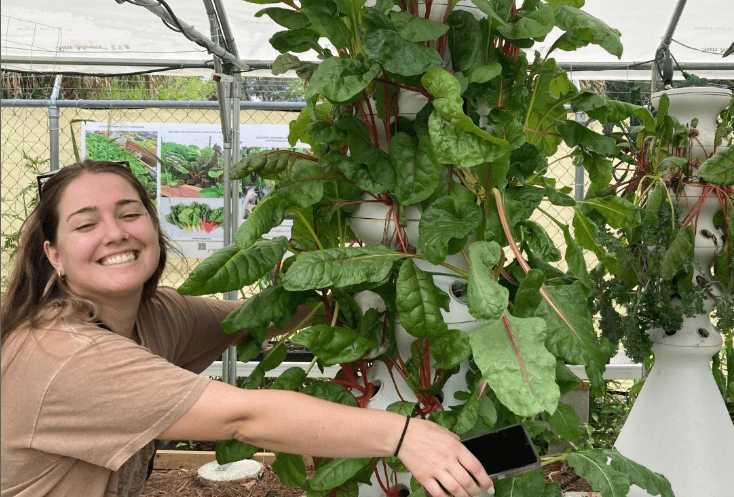
Healthy nutritious food grown in the Zero Lot – additional growing containers added to the Zero Lot: NFT, vertical towers and an additional raft bed.
The video below is an update to the Zero Lot, or as some visitors called it, the “Kitchen Garden” after it has been in operation for five months:
I became the Aquaponics training partner of IDEAS for US in early 2012. The following video is of a farm tour in Spring 2013, almost one and half years after the Zero Lot was first developed. Seeing is believing. I was just planting the seeds in many minds. So many people were inspired and went on to learn more and take the next step in growing some of their own food. Would you like to grow some of your own healthy nutritious food in your own space?

